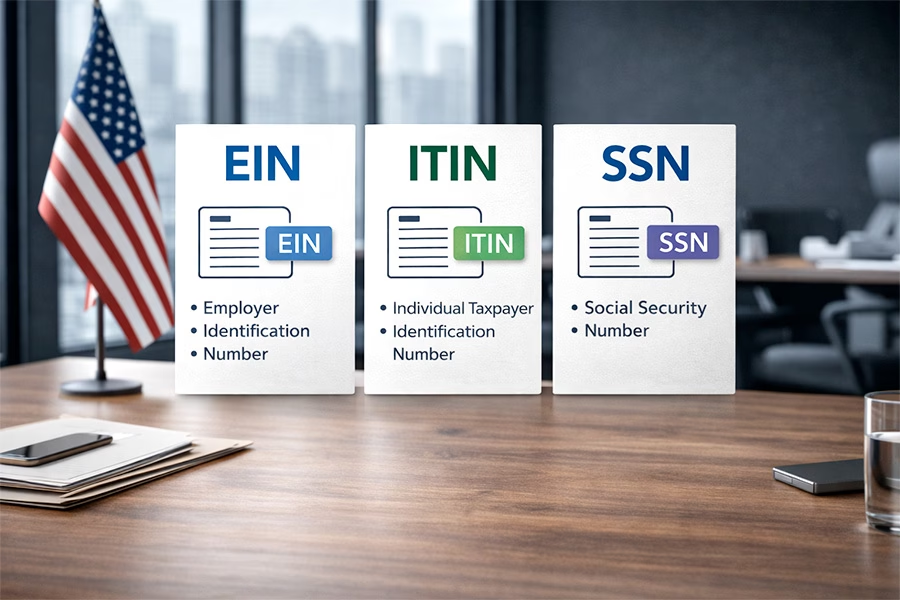
The term “Tax ID” in the United States creates a great deal of confusion, especially among foreigners who are setting up an LLC, opening a bank account, or trying to properly comply with the IRS. Many people use “Tax ID,” “EIN,” “ITIN,” and “SSN” as if they were the same thing, when in reality they are distinct identifiers with different functions, users, and limitations.
Understanding this difference is not a minor detail. Choosing the wrong number or assuming that one replaces another can lead to rejected forms, delays in processes, banking issues, and tax errors that later take time and money to correct.
In this guide, you will clearly see what a Tax ID in the U.S. really is, how it differs from an EIN, ITIN, and SSN, what each one is used for, their limitations, and which one may be required depending on each person’s or company’s situation.
What is a Tax ID (TIN) in the United States
In the United States, the term “Tax ID” is generally used to refer to a tax identification number. However, the technical term used by the IRS is Taxpayer Identification Number (TIN).
The TIN is not a single or universal number. It is a category that includes different tax identifiers used to recognize individuals and entities before tax authorities. Depending on who the taxpayer is and their legal situation, the TIN can take different forms, such as an EIN, ITIN, or SSN.
Its main function is to allow the IRS to track tax obligations, filings, payments, and financial reports associated with a specific taxpayer. Without this number, it is not possible to properly comply with most tax-related processes in the country.
The TIN is required in a wide variety of situations, including:
- Filing tax returns
- Opening business or personal bank accounts
- Financial reporting to tax authorities
- Hiring employees or providing services
- Identification before financial institutions
It is important to understand that obtaining a Tax ID does not grant immigration status, work authorization, or residency rights. Its function is exclusively tax-related.
Therefore, when an institution requests a “Tax ID,” it is actually asking for the tax identification number corresponding to the type of taxpayer, not a specific document.
EIN: tax number for businesses
It is a unique nine-digit number issued by the IRS in the format XX-XXXXXXX. It identifies the entity — not its owners — in all tax filings, reports, and communications.
The EIN allows the IRS to link:
- Entity tax returns
- Payments and withholdings
- Informational forms filed with third parties
- Tax compliance history
- Employer activity, if applicable
Without an EIN, most federal business obligations cannot be properly fulfilled.
Who must obtain it
The following must apply for an EIN, among others:
- LLCs formed in the U.S. (single-member or multi-member)
- Corporations (C Corp or S Corp)
- Partnerships
- Entities that hire employees in the U.S.
- Businesses required to file business tax returns
- Entities that must withhold or report payments to third parties
In practice, even a foreign-owned single-member LLC with no significant business activity typically needs an EIN to comply with Form 5472 and other informational obligations.
What it is used for
The EIN is required in a wide range of operational and regulatory processes, for example:
- Filing federal business tax returns
- Complying with IRS informational obligations
- Opening business bank accounts in the U.S.
- Registering with payment processors and financial platforms
- Hiring and paying employees
- Issuing forms such as W-2 or 1099
- Applying for business licenses and permits
- Entering into contractual relationships with suppliers or institutional clients
Many private institutions use the EIN as the standard corporate identifier.
EIN for foreigners and LLCs
One of the most relevant aspects is that foreign owners can obtain an EIN without being residents or having an SSN. The IRS allows it to be requested for entities legally formed in the U.S., even when their owners live outside the country.
However, obtaining it may require specific procedures when there is no responsible party with an SSN or ITIN, and a “responsible party” associated with the entity must typically be designated.
It is important to understand that the EIN exclusively identifies the company. It does not replace the owner’s personal identification and does not imply that the individual has personal tax obligations in the U.S. by itself.
Limitations of the EIN
The EIN is essential for the company, but it has clear limitations that often create confusion among foreigners:
- It does not identify a natural person nor serve as a personal document
- It does not replace an SSN or ITIN when individual identification is required
- It does not grant work authorization, residency, or immigration status
- It does not provide access to Social Security benefits
- It does not guarantee the opening of bank accounts or financial services
- It does not eliminate any personal tax obligations that may exist
- It does not automatically authorize operations in all states
In many processes — especially banking or personal — an individual identifier for the owner is also required.
Understanding what an EIN can and cannot do is essential to avoid rejections, delays, and incorrect expectations when operating a business in the United States.
ITIN: tax number for individuals without an SSN
The Individual Taxpayer Identification Number (ITIN) is a tax identification number assigned by the IRS to individuals who must comply with tax obligations in the United States but are not eligible to obtain a Social Security Number (SSN).
Its purpose is exclusively tax-related. The ITIN allows the IRS to process returns, payments, and reporting associated with individuals who, due to their immigration status or residency, do not qualify for an SSN but still have tax responsibilities in the country.
This number is especially relevant for foreign owners of LLCs, non-resident investors, partners of U.S. entities, and individuals who receive income subject to U.S. taxation.
What the ITIN is
It is a nine-digit number issued by the IRS in the format 9XX-XX-XXXX. Unlike the SSN, it is not issued by the Social Security Administration and is not linked to social benefits or federal programs.
- The ITIN allows the individual taxpayer to be identified in:
- Personal tax returns
- IRS informational forms
- Tax withholdings applicable to non-residents
- Financial reports related to tax obligations
- Claims for benefits under international tax treaties
Without an ITIN, many foreign individuals would not be able to comply with their U.S. tax responsibilities, even when they do not reside in the country.
Who can apply for it
The following, among others, can apply for an ITIN:
- Non-resident foreigners who must file a tax return in the U.S.
- Foreign owners of LLCs with personal tax obligations
- Foreign partners of U.S. partnerships
- Investors with income sourced from the U.S.
- Dependents or spouses in certain specific cases
- Individuals claiming tax treaty benefits
Obtaining an ITIN usually requires demonstrating the tax need through official documentation and the submission of a related return or form.
When it is required
An ITIN is required when a person who is not eligible for an SSN must identify themselves before the IRS to comply with personal tax obligations, for example:
- Reporting effectively connected income (ECI)
- Reporting participation in a U.S. entity
- Receiving payments subject to tax withholding
- Claiming refunds or tax treaty benefits
- Filing joint tax returns when one spouse does not have an SSN
Not everyone with an LLC needs an ITIN; it depends on whether there is an individual tax obligation or direct interaction with the U.S. tax system.
Main uses
Among the most common uses of the ITIN are:
- Filing individual tax returns
- Being identified as a partner or beneficiary in U.S. entities
- Meeting tax requirements for investments in the U.S.
- Receiving payments subject to withholding with proper documentation
- Interacting with the IRS when an SSN is not available
Some financial institutions may also accept it as a tax identifier, although they are not required to do so.
ITIN for foreign LLC owners
In the context of an LLC with a foreign owner, an ITIN may be required when the owner has personal tax obligations separate from the entity, for example:
- When there is ECI attributable to the owner
- When the structure is a partnership and the partner must report their share
- When personal identification is required in tax forms
- To apply tax treaties or reduced withholding rates
It is important to distinguish that the EIN identifies the company, while the ITIN identifies the individual.
Cases where a person may have more than one Tax ID
A foreign individual may simultaneously have multiple valid tax numbers depending on their role:
- EIN → as the owner or responsible party of a company
- ITIN → as an individual taxpayer not eligible for an SSN
- SSN → if they later obtain eligible immigration status
These numbers do not automatically replace one another, and each serves different functions within the tax system.
Limitations of the ITIN
The ITIN often creates incorrect expectations, so it is essential to understand its limitations:
- It does not authorize legal work in the United States
- It does not grant immigration status or residency
- It does not provide access to Social Security benefits
- It does not replace the SSN if the person is eligible to obtain one
- It does not serve as general proof of identity outside the tax context
- It does not allow voting or access to federal programs reserved for eligible citizens or residents
- It does not guarantee access to financial or credit services
Additionally, the ITIN may expire if it is not used for certain periods or if the IRS updates its administrative criteria.
Understanding these limitations is essential to avoid misconceptions about what having a personal tax identification number in the United States actually implies.
SSN: Social Security Number
The Social Security Number (SSN) is the most important personal identifier within the legal, tax, and financial system of the United States. It is issued by the Social Security Administration (SSA) and assigned to U.S. citizens and certain foreign individuals who have legal authorization to work in the country.
Although its origin is linked to the Social Security system, today the SSN functions as the central personal identification number for taxes, employment, government benefits, credit, financial history, and identity verification. In practice, it is the closest equivalent to a comprehensive tax and employment identification document within the U.S. system.
Unlike the ITIN, the SSN not only allows compliance with tax obligations but also enables labor rights, access to public programs, full participation in the financial system, and the accumulation of Social Security benefits throughout a person’s working life.
What the SSN is
It is a unique nine-digit number in the format XXX-XX-XXXX assigned for life to an individual. Its primary function is to allow the federal government to track taxable income, contributions to the Social Security system, and eligibility for benefits such as retirement, disability, or survivor benefits.
The SSN is used as a personal identifier with multiple agencies and entities, including:
- The IRS for personal tax returns and tax reporting
- Employers for payroll reporting, withholdings, and W-2 forms
- The SSA to record contributions and calculate future benefits
- Financial institutions for opening accounts and credit evaluation
- Federal and state agencies for administrative processes
- Employment verification systems such as E-Verify
- Educational, healthcare, and insurance entities in certain processes
For this reason, the SSN becomes the foundational identifier for virtually all economic and administrative interactions of an individual within the U.S.
Who can obtain it
The SSN is not available to all foreign individuals. Only those whose immigration status allows it may obtain one:
- U.S. citizens
- Lawful permanent residents (Green Card holders)
- Foreign individuals with employment authorization granted by the Department of Homeland Security (DHS)
- Certain specific categories of non-immigrants with work authorization linked to their visa
Individuals who do not have authorization to work in the U.S. are not eligible for an SSN. If they need to comply with tax obligations, they must apply for an ITIN.
SSN for employment and restriction annotations
In the case of foreign individuals, the SSN card may include annotations that determine its employment use:
- No restrictions: the holder is authorized to work freely in the U.S.
- Valid only with DHS authorization: requires valid immigration permission for employment
- Not valid for employment: issued in limited situations for federal administrative purposes
These annotations do not change the number itself, but legally condition its use in the labor market.
Main uses of the SSN
The SSN has the broadest scope of all personal Tax IDs. It is used to:
- Work legally in the United States and receive officially reported wages
- File personal tax returns with the IRS
- Accumulate credits for retirement and other Social Security benefits
- Access federal or state programs when eligibility requirements are met
- Open personal bank accounts and obtain full financial services
- Build credit history and apply for loans or mortgages
- Background checks and employment eligibility verification
- Administrative, educational, and insurance processes
In practice, many private institutions request it as the standard identifier, even when they could legally accept other forms of identification.
SSN for business owners and LLCs
When a business owner in the U.S. has an SSN, this number is used to identify them personally before the IRS and other authorities, while the company maintains its own tax identity through the EIN.
In business structures such as single-member LLCs, especially when they are treated as disregarded entities for tax purposes, the company’s economic results may be passed directly to the owner’s personal tax return, associated with their SSN.
Additionally, the SSN may be required for:
- Opening business bank accounts when the owner is a signatory
- Banking risk and compliance assessments
- Credit or financing applications for the company
- Identity verification on financial platforms and with providers
However, the SSN never replaces the EIN as the entity’s identifier.
Key differences with ITIN
Although both numbers allow compliance with personal tax obligations, their scope and purpose are very different:
- The SSN authorizes legal work in the U.S.; the ITIN does not
- The SSN is linked to social benefits; the ITIN is not
- The SSN is issued by the SSA; the ITIN is issued by the IRS
- The SSN allows building credit history; the ITIN only in limited cases
- The SSN is mandatory when the individual is eligible to obtain it
- The ITIN is used only when an SSN cannot be obtained
If a person who was using an ITIN later obtains an SSN, the IRS generally links their prior tax history to the new number to maintain continuity of records.
Limitations of the SSN
Despite its broad scope, the SSN does not imply all rights nor eliminate tax or legal obligations:
- It is only available to individuals with eligible immigration status
- It does not replace the EIN for company tax obligations
- It does not automatically grant citizenship or permanent residency
- It does not eliminate federal or state taxes
- It does not guarantee automatic access to credit or public benefits
- It does not protect against audits or tax inquiries
Additionally, improper acquisition or use of an SSN can have severe legal consequences.
SSN security and protection
The SSN is one of the most sensitive personal data points in the United States and a frequent target of fraud and identity theft. Its exposure can enable the opening of accounts, contracts, or fraudulent credit in the holder’s name.
For this reason, it is recommended to:
- Share it only when strictly necessary
- Verify the legitimacy of the entity requesting it
- Avoid sending it through unsecured channels
- Not carry the physical card unnecessarily
- Monitor credit reports when possible
Understanding the full scope of the SSN allows you to properly place its role within the U.S. Tax ID system and distinguish when to use SSN, ITIN, or EIN depending on personal, immigration, and business circumstances.
Although they are all referred to as “Tax ID,” EIN, ITIN, and SSN are not different versions of the same number — each one exists to identify a specific role within the United States tax system.
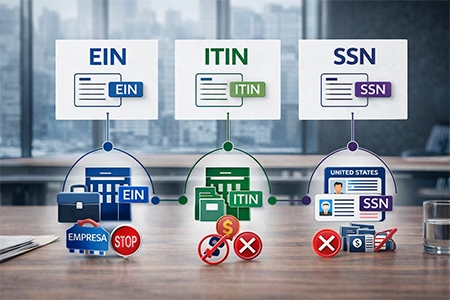
Key differences between EIN, ITIN, and SSN (direct comparison)
Although the three numbers are often grouped under the general term “Tax ID,” they actually serve completely different functions within the U.S. tax, legal, and financial system. Confusing them can lead to serious errors, from incorrect applications to tax noncompliance or banking issues.
The main difference is simple but fundamental:
- EIN identifies an entity (company)
- SSN identifies an individual with work authorization
- ITIN identifies an individual without an SSN who must comply with tax obligations
Each one exists to solve a different problem within the system.
General comparison
| Characteristic | EIN | ITIN | SSN |
|---|---|---|---|
| Identifies | Legal entities (LLC, corp, partnership) | Individuals not eligible for SSN | Individuals with work authorization or eligible status |
| Issued by | IRS | IRS | Social Security Administration |
| Main purpose | Business tax identification | Individual tax compliance | Comprehensive tax, employment, and administrative identification |
| Allows legal work | No | No | Yes, if immigration status allows |
| Linked to social security | No | No | Yes |
| Used in tax filings | Business | Personal | Personal |
| Required for payroll and employment | Yes, for employers | No | Yes, for employees |
| Acceptance in banking and credit | High for businesses | Limited | Very high |
| Can replace another | No | No | No |
| Available to non-resident foreigners | Yes | Yes, if there is a tax obligation | No |
| Grants residency or visa | No | No | No |
| Can identify a company | Yes | No | No |
| Can identify a person | No | Yes | Yes |
| Provides social benefits | No | No | Potentially yes |
Which number to use in each situation
| Context | Situation | Required Tax ID |
|---|---|---|
| For businesses and operations | Create and operate an LLC or corporation | EIN |
| Business tax filings | EIN | |
| Hiring employees | EIN | |
| Open a business bank account | Usually EIN | |
| For personal tax obligations | Foreign individual without SSN who must file taxes | ITIN |
| Individual with work authorization or residency | SSN | |
| Foreign LLC owner (company + individual) | EIN + ITIN or SSN | |
| For employment in the U.S. | Work legally as an employee | SSN required |
| ITIN | Does not authorize employment | |
| EIN | Corresponds to the employer, not the worker | |
| For banking and credit | Business account | Mainly EIN |
| Full personal account | Usually SSN | |
| Some banks accept ITIN | With limitations |
Situations where a person may have more than one Tax ID
| Profile | Applicable Tax IDs |
|---|---|
| Foreign owner of an LLC | EIN (company) + ITIN (individual) |
| Foreign entrepreneur who later obtains residency | EIN + prior ITIN + new SSN (the ITIN is no longer used) |
| U.S. citizen with a company | SSN (individual) + EIN (company) |
Each number serves a different function and they do not replace one another.
Common mistakes to avoid
One of the main issues for foreigners is assuming that all Tax IDs are interchangeable. Among the most common mistakes are:
- Believing that an EIN works as personal identification
- Thinking that an ITIN allows legal work
- Assuming that an SSN replaces an EIN for a company
- Requesting the wrong number to open accounts or fulfill tax obligations
- Not applying for an ITIN when there is a personal reporting obligation
These mistakes can lead to administrative rejections, operational delays, or tax non-compliance.
How to know which one you actually need
The correct way to determine the appropriate number is to first identify your role within the system:
- Are you acting as an individual or as a company?
- Do you have authorization to work in the U.S.?
- Do you need to file personal taxes or only business taxes?
- Are you a resident, nonresident, or foreign entity?
Answering these questions allows you to accurately identify which Tax ID you should apply for or use.
This understanding is essential to operate legally in the United States, especially for international entrepreneurs, LLC owners, and professionals who interact with the U.S. tax system without residing in the country.
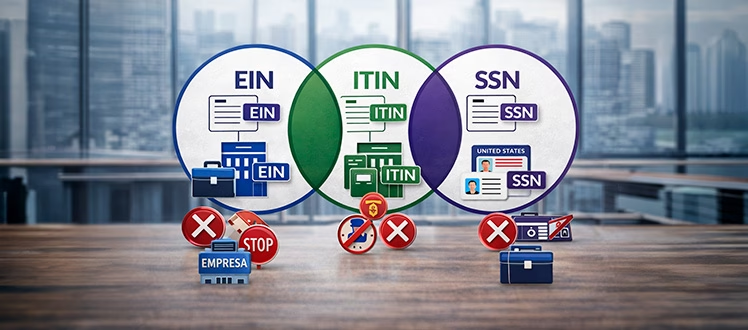
Limitations and real scope of each number
Understanding what each Tax ID allows is important, but understanding what it does NOT allow is even more critical. Many legal, tax, and operational issues arise precisely from assigning functions to these numbers that they do not have.
EIN, ITIN, and SSN are not equivalent or interchangeable. Each exists for a specific purpose and has clear limitations within the U.S. system.
Limitations of EIN (Employer Identification Number)
The EIN identifies an entity, not a person. Therefore:
- It does not serve as personal identification for the owner
- It does not authorize working in the U.S.
- It does not grant immigration status or residency
- It does not replace SSN or ITIN for personal obligations
- It does not provide access to social benefits
- It does not create a personal credit history
Although some institutions may request the EIN along with the owner’s personal information, the number itself only represents the company before the IRS and other agencies.
Additionally, having an EIN does not mean the company is active or compliant. Compliance depends on filings, reporting, and additional state requirements.
Limitations of ITIN (Individual Taxpayer Identification Number)
The ITIN is exclusively a tax number for individuals who cannot obtain an SSN. Its scope is deliberately limited:
- It does not authorize employment in the U.S.
- It does not grant immigration status
- It does not provide access to social security benefits
- It does not replace the SSN if the person is eligible for one
- It does not function as general identification outside the tax context
- It does not guarantee opening bank accounts or access to credit
The ITIN exists solely to allow an individual to comply with federal tax obligations or receive certain tax benefits when applicable.
Additionally, it may expire if not used for certain periods or if it belongs to older series, requiring renewal before filing new returns.
Limitations of SSN (Social Security Number)
The SSN has the broadest scope, but it does not imply absolute rights:
- It does not replace the EIN for business obligations
- It does not eliminate federal or state taxes
- It does not guarantee automatic access to credit or financial services
- It does not grant citizenship or permanent residency
- It does not protect against audits or tax compliance requirements
- It does not eliminate international reporting obligations (FBAR, FATCA, etc.)
Additionally, the SSN is highly sensitive. Misuse or careless disclosure can result in fraud or identity theft.
What no Tax ID does on its own
Regardless of the type of number, none of them:
- Automatically legalizes a business
- Guarantees tax compliance
- Avoids taxes
- Replaces professional advice
- Protects against penalties for non-compliance
- Allows operation without other required licenses or registrations
- Grants the right to live or work in the U.S.
A Tax ID is only an identification tool within a much broader regulatory system.
Why understanding these limitations is essential
Many international entrepreneurs create LLCs in the United States believing that obtaining an EIN or an ITIN means they are fully compliant or authorized to operate without restrictions. This perception is incorrect.
In reality, compliance depends on multiple additional factors:
- Type of economic activity
- Location of operations
- Physical presence or employees
- Federal, state, and personal obligations
- Industry regulations
- Banking and compliance requirements
For this reason, a Tax ID should be viewed as one component of the system, not a complete solution.
Which Tax ID a foreigner with a U.S. LLC needs
Determining which Tax ID applies to a foreigner with an LLC in the United States is one of the most important—and most misunderstood—questions. There is no single answer for all cases, because the correct combination depends on the company structure, the owner’s immigration status, the existence of personal tax obligations, and how the business activity is carried out.
In general terms, an LLC owned by a foreigner involves at least two distinct levels of identification: one for the entity and another for the individual. Confusing these levels can lead to non-compliance, operational delays, or rejections by the IRS or financial institutions.
Most common scenarios
The most typical cases for foreign owners include:
- Non-resident foreigner with a single-member LLC → generally requires an EIN for the company; may require an ITIN if there are personal tax obligations.
- LLC with multiple foreign partners → EIN for the entity and, in many cases, ITIN for each partner if they must report their share of income.
- Foreign owner who later obtains work authorization or residency → EIN for the company and SSN for personal obligations.
- Company with employees in the U.S. → EIN required for payroll and employment reporting, regardless of the owner’s status.
The determining factor is whether there is a personal tax obligation with the IRS in addition to the business one.
Possible combinations (EIN + ITIN, etc.)
It is completely normal for a foreign entrepreneur to have more than one Tax ID at the same time. Some typical combinations include:
- EIN + ITIN → Company owned by a non-resident foreigner with personal tax obligations.
- EIN + SSN → Company whose owner is a citizen, resident, or foreigner authorized to work.
- EIN only → Limited cases where the owner has no personal filing obligation in the U.S.
These numbers do not replace one another, because they identify different subjects within the system: the company and the individual.

Common mistakes
Among the most common mistakes are:
- Thinking that the EIN covers all personal tax obligations of the owner.
- Not applying for an ITIN when there is an individual filing obligation.
- Trying to use an ITIN as a substitute for an SSN for employment.
- Believing that only one Tax ID is needed to operate legally.
- Filing forms with the wrong number, which can lead to automatic rejections.
Avoiding these mistakes is essential to keep the LLC compliant and operational.
How to obtain each type of Tax ID
Obtaining a Tax ID in the United States is not simply a matter of filling out a form. Each number—EIN, ITIN, or SSN—follows a different logic, is issued by a different authority, and requires specific conditions. For this reason, one of the most common mistakes is trying to obtain the correct number through the wrong process, or assuming that all of them are requested from the IRS in the same way.
To clearly understand this, it is useful to separate three key questions:
- Which number you actually need
- Which authority issues it
- What documents or prior conditions are required
Only after these three variables are clear does it make sense to begin the application process.
General procedures
1) How to obtain an EIN
The EIN is issued by the IRS and is designed to identify the business entity, not the owner. In the case of an LLC or corporation, the application is typically made once the entity has been legally formed and basic information is defined, such as name, address, and responsible party.
In general terms, the process begins with completing Form SS-4, which includes:
- legal name of the entity
- type of entity
- reason for applying
- business address
- name of the responsible party
- main business activity
Depending on the applicant’s situation, the EIN can be obtained through different methods:
- Online application: usually available when the responsible party has an SSN or ITIN and meets IRS system requirements.
- Fax or mail: very common for foreign owners who do not have a U.S. personal identifier.
- International phone: in some cases, the IRS allows processing for applicants outside the U.S.
The key point here is understanding that the EIN does not require the owner to be a resident, citizen, or have an SSN. What it does require is that the company is formally established and that the application is properly structured.
2) How to obtain an ITIN
The ITIN is also issued by the IRS, but its logic is completely different. It is not requested for a company, but for an individual who needs to be identified for tax purposes and cannot obtain an SSN.
The application is made using Form W-7. However, the ITIN is not typically processed as a “preventive” number or for simple convenience. The IRS generally requires a concrete tax need, for example:
- filing a tax return
- being listed as a partner or beneficiary with reporting obligations
- claiming benefits under a tax treaty
- complying with a formal requirement of the tax system
For this reason, in many cases the W-7 is submitted together with:
- a federal tax return
- supporting forms
- evidence of why the number is required
The key point is this: not every foreigner with an LLC automatically needs an ITIN. It is required when there is a real personal tax obligation.
3) How to obtain an SSN
The SSN is not issued by the IRS, but by the Social Security Administration (SSA). This completely changes the nature of the process. The SSN is not obtained due to tax necessity, but due to legal eligibility within the U.S. system, especially through citizenship, permanent residency, or work authorization.
For this reason, the SSN process depends on the applicant’s immigration status. It generally requires:
- physical presence in the U.S.
- proof of identity
- valid immigration basis
- documentation proving authorization to work, when applicable
In many cases, the SSN is not “requested as a tax strategy,” but rather obtained as a consequence of having an immigration status that allows it.
Required documentation
Although each case may vary, there is a basic documentation logic behind each number.
For EIN:
The focus is on the company and the responsible party. Typically required:
- legal entity details
- tax or business address
- type of structure
- information of the responsible party
- reason for application
In applications from foreigners, one of the most sensitive points is correctly identifying the responsible party, as mistakes in this section can lead to rejections or delays.
For ITIN:
The focus is on personal identity and tax necessity. Typically required:
- Form W-7
- passport or another accepted identification document
- proof of foreign status
- tax return or supporting documentation
- certified copies when originals are not submitted
The most common mistake here is assuming that a simple copy of a passport is enough or that the ITIN is granted without justifying why it is needed.
For SSN:
The focus is on identity, status, and legal authorization. Typically required:
- proof of identity
- proof of age
- valid immigration documents
- work authorization or eligible status
In this case, the critical aspect is usually not tax-related, but rather immigration and administrative.
Estimated timelines
Timelines vary significantly depending on the method, the agency’s workload, and the quality of the application.
EIN
- online: can be issued the same day if the system accepts the application
- by fax: typically takes days or a few weeks
- by mail: usually takes longer and requires a wider time margin
ITIN
- typically the slowest process, as it involves document review and identity verification
- often takes several weeks or even months, depending on timing and case complexity
SSN
- generally issued after validation of immigration eligibility and processing with the SSA
- timelines are usually measured in weeks, though they may vary
What typically complicates these processes
Although the procedure may seem simple in theory, in practice several factors can lead to delays or rejections:
- requesting the wrong number for the actual situation
- using outdated forms
- incorrectly completing applicant or company information
- submitting non-certified documents when certified copies are required
- failing to properly justify the need for an ITIN
- confusing the company’s responsible party with another role
- assuming that having an LLC automatically entitles you to a personal tax number
How to avoid mistakes from the start
The safest way to approach these processes is to first think about the full structure:
- whether the number is for the company or the individual
- whether there is a real tax obligation or only an operational need
- whether the applicant has eligibility for an SSN
- whether the LLC will also require personal identification from the owner
When this evaluation is done correctly, obtaining a Tax ID stops being a confusing process and becomes an organized part of the business’s tax and operational structure.
In other words, it’s not just about “how to get a number,” but about getting the right number, through the correct process, and for the appropriate purpose.
Risks of using the wrong number
Using the wrong Tax ID — or using the correct number in the wrong context — can lead to consequences that go far beyond a simple administrative error. In the U.S. system, tax identification numbers are deeply integrated into compliance processes, identity verification, banking, and regulatory reporting. As a result, inconsistencies can trigger automatic rejections, operational blocks, or even sanction exposure.
Tax-related issues
Incorrect use of an identifier can prevent returns, forms, or payments from being properly matched to the corresponding taxpayer. The most common consequences include:
- Electronic rejection of tax returns due to identification inconsistencies
- Inability to match income reported by third parties (e.g., informational forms)
- IRS notices due to discrepancies between records
- Delays in refunds or processing of filings
- Exposure to penalties for incorrect or incomplete filing
A typical example is submitting personal documentation using an EIN or business documentation using an SSN/ITIN, which breaks system traceability and requires later correction.
Additionally, if a foreign owner was required to report personal income and did not have the appropriate number (for example, an ITIN), noncompliance may arise even if the company itself operated correctly.
Banking and compliance issues
Financial institutions in the U.S. operate under strict verification standards (KYC/AML). The identification number is a central component of these controls.
Using an incorrect or inconsistent Tax ID may result in:
- Rejection when opening personal or business accounts
- Additional documentation requests or enhanced verification procedures
- Significant delays in banking onboarding processes
- Usage restrictions or operational limits
- Preventive account closure due to compliance risk
For example, attempting to open a business account using only an SSN or without an EIN when required, or using an ITIN where a bank requires an SSN for certain products, can completely block the process.
Rejection of forms and administrative processes
Many government and private systems automatically validate consistency between the type of form and the type of identifier used. When there is a mismatch, the process simply does not move forward.
Among the most common situations:
- Tax forms returned due to missing or invalid identification
- Inability to file electronically (e-file)
- Rejection of registrations with federal or state agencies
- Issues in hiring processes or employment verification
- Obstacles in obtaining business licenses or permits
These rejections do not always clearly explain the reason, which creates confusion and leads to loss of time.
Operational and commercial risks
Beyond tax and banking implications, using an incorrect identifier can affect the ability to operate normally:
- Difficulties in signing contracts with suppliers or clients
- Issues with payment platforms or marketplaces
- Delays in due diligence processes
- Barriers to receiving investment or financing
- Inconsistencies in audits or internal reviews
In international environments, where document verification is strict, these inconsistencies may be perceived as risk indicators.
Cumulative effect of the error
One of the most problematic aspects is that these risks can accumulate. A misused number can trigger cascading corrections: amended returns, banking updates, clarifications with the IRS, and compliance reviews.
The longer the issue remains uncorrected, the higher the administrative cost and the complexity of resolving the situation.
How to prevent these risks
Prevention starts by correctly identifying the role of each number within the structure:
- EIN for the entity
- SSN or ITIN for the individual, depending on eligibility
- Consistent use of the same identifier across all related forms
- Prior review before submitting official documents
In essence, a Tax ID is not a minor technical detail. It is the foundational identifier upon which tax, banking, and regulatory obligations are built in the United States. Using the correct number from the beginning significantly reduces the likelihood of operational disruptions and unnecessary costs.
Using the wrong Tax ID is not just an administrative mistake: it can result in banking rejections, operational delays, tax issues, and even penalties for non-compliance.
Conclusion
Understanding what a Tax ID is in the United States and how EIN, ITIN, and SSN differ is essential for any individual or business interacting with the country’s tax, financial, or commercial system. These numbers are not interchangeable and do not serve the same purpose: each identifies a different subject — entity or individual — and responds to specific legal requirements.
For foreign-owned LLCs, this distinction is especially critical. A U.S. business structure may involve multiple layers of identification at the same time: the EIN for the entity and the ITIN or SSN for the owner, depending on their tax and immigration status. Using the wrong number or assuming one replaces another can lead to administrative rejections, tax noncompliance, or operational issues with banks and platforms.
Additionally, obtaining a Tax ID does not automatically mean you are authorized to work, reside in the U.S., or fully comply with all tax obligations. The number is only one component within a broader system that includes federal and state regulations, as well as ongoing compliance requirements.
For this reason, before applying for or using any tax identifier, it is essential to understand which one truly applies to your personal and business situation. This clarity helps avoid costly mistakes, operate with greater legal certainty, and properly leverage the advantages of a U.S. structure.
If you have an LLC in the United States or are considering creating one, correctly identifying which Tax ID you need — and how to use it consistently — can make the difference between a functional structure and a permanent administrative problem.
A specialized assessment allows you to:
- Determine which tax identification numbers apply to your company and to you as the owner
- Identify both personal and business tax obligations
- Avoid common mistakes that lead to rejections or penalties
- Prepare your structure to operate with banks and international platforms
- Ensure consistency across tax, immigration, and operational compliance
Making informed decisions from the start reduces risks, future costs, and obstacles to international growth.
Frequently Asked Questions (FAQ)
What exactly is a Tax ID in the United States?
“Tax ID” or “TIN” is a general term used to refer to any number used by the federal government to identify a taxpayer. It is not a single number. It may refer to an EIN, ITIN, or SSN depending on the case.
Are Tax ID, TIN, EIN, ITIN, and SSN the same thing?
No. “Tax ID” or “TIN” is a general term that includes different types of tax identification numbers. The most relevant are:
- EIN → identifies companies or entities
- ITIN → identifies individuals without an SSN who must meet tax obligations
- SSN → identifies individuals eligible to work or reside in the U.S.
Each serves a different function and cannot replace the others.
Using them interchangeably is incorrect and can lead to form rejections, tax inconsistencies, or banking issues.
What is the Tax ID for a company in the United States?
The tax identifier for a company is the EIN (Employer Identification Number). This number allows the entity to file tax returns, pay taxes, hire employees, and operate formally with authorities and third parties.
Does the EIN identify the owner of the company?
No. The EIN identifies only the entity. The owner has their own personal identifier (ITIN or SSN). Confusing the two is a common mistake that can create inconsistencies in forms and reporting.
What is the personal Tax ID in the United States?
It depends on the person’s eligibility:
- SSN → for individuals authorized to work or reside
- ITIN → for individuals not eligible for an SSN but with tax obligations
Do I need an ITIN if I already have an EIN?
It depends. The EIN covers the company’s obligations, but not personal ones. If the owner must file individual tax returns or report income derived from the LLC, they may need an ITIN even if the company already has an EIN.
What happens if I never obtain the required Tax ID?
This can result in tax noncompliance, inability to file returns, mandatory withholding on income, banking issues, or limitations on operating legally.
Can a non-resident foreigner have an LLC with an EIN without living in the U.S.?
Yes. U.S. law allows non-residents to form entities in the U.S. and obtain an EIN without residing in or traveling to the country. The EIN does not depend on the owner’s immigration status, but on the legal existence of the entity. However, having an EIN does not mean the owner is authorized to work or reside in the U.S.
Do I always need an ITIN if I am a foreign owner of an LLC?
Not necessarily. An ITIN is only required when there is a personal tax obligation with the IRS, for example:
- reporting income attributable to the LLC
- being listed as a partner with reportable participation
- claiming tax treaty benefits
- receiving certain payments subject to withholding
If there is no personal obligation, it may not be required. Determining this requires analyzing the entity’s tax classification and the nature of the activity.
Do I need an ITIN if I already have an EIN?
It depends. The EIN covers the company’s obligations, but not personal ones. If the owner must file individual tax returns or report income derived from the LLC, they may need an ITIN even if the company already has an EIN.
Can an ITIN be used as official identification?
No, in most cases. The ITIN is a tax identification number, not a general ID document or proof of immigration status.
What happens if a foreign-owned single-member LLC has no U.S. income?
Even if there is no income tax, informational obligations may still exist (for example, reporting transactions with related parties). In such cases, the EIN remains mandatory for the company, while the owner’s ITIN depends on whether they need to report personal information to the IRS.
Can I work in the U.S. using an ITIN or my company’s EIN?
No. Neither of them authorizes employment. Only an SSN linked to a valid immigration status allows you to work legally. Using an ITIN or EIN for employment purposes may constitute a violation of immigration and labor laws.
Does the SSN replace the company’s EIN or vice versa?
No. They identify different subjects. Even if the owner has an SSN, the company must use its own EIN for tax filings, payroll, business banking, and regulatory reporting.
Can an LLC have employees without an EIN?
No. An EIN is mandatory for any business that hires workers in the U.S., as it is used to report wages, withholdings, and contributions to the employment and social security systems.
Can I have an LLC in the U.S. without an SSN?
Yes. Thousands of LLCs are owned by foreign individuals without an SSN. In these cases:
- The company uses an EIN
- The owner may need an ITIN if they have personal obligations
Can a person have an EIN, ITIN, and SSN at the same time?
Yes, under certain circumstances. For example, a foreign entrepreneur may have:
- An EIN for their company
- An ITIN for personal tax obligations as a non-resident
- An SSN later if they obtain work authorization or residency
When an SSN is obtained, the IRS typically links the prior ITIN history to the new number.
Is it possible to open a business bank account using only an EIN?
In many cases, yes, but financial institutions typically require additional information about the owner to comply with identification standards (KYC/AML). Depending on the bank, an SSN, ITIN, or other personal documents may be required.
Does having a Tax ID guarantee opening a bank account?
Not necessarily. Banks evaluate multiple compliance factors, such as corporate documentation, ownership structure, business activity, and regulatory risk. A Tax ID is necessary, but not sufficient on its own.
Does a Tax ID function as a general identification document in the U.S.?
No. No Tax ID replaces official identification documents. They are administrative numbers used for tax and verification purposes within specific systems.
Is it mandatory to have a Tax ID to operate an LLC legally?
Yes, at least an EIN for the entity. Additionally, the owner may need an SSN or ITIN depending on their personal obligations and immigration status. Without the correct identifiers, it becomes difficult to file reports, open accounts, or interact with authorities.
What happens if I obtain the wrong Tax ID or request one unnecessarily?
This can lead to additional processes to correct records, inconsistencies in tax and financial systems, or delays in operations. For this reason, it is recommended to first determine which number actually applies before initiating any application.
In some cases, it may also result in noncompliance if forms are filed with incorrect identification.
Is it possible to have more than one Tax ID at the same time?
Yes. It is common for a foreign individual with a U.S. company to have:
- An EIN for the entity
- An ITIN or SSN for personal obligations
These numbers serve different purposes and can coexist without issue.
Does having a Tax ID mean I must pay taxes in the U.S.?
Not necessarily. Having a tax identification number simply means there is a record within the system. The obligation to pay taxes depends on economic activity, tax classification, and other legal factors.
Does a Tax ID expire or need to be renewed?
- EIN → does not expire
- SSN → does not expire
- ITIN → may expire if not used for certain periods or if required by the IRS
Why is it so important to choose the correct Tax ID?
Because it determines how the government identifies the taxpayer and defines which obligations apply. Incorrect identification can affect taxes, compliance, banking, and business operations.